
ReplacesMRI EvolutionJoblogicLimble
Assets
vs the standalone CMMS asset register
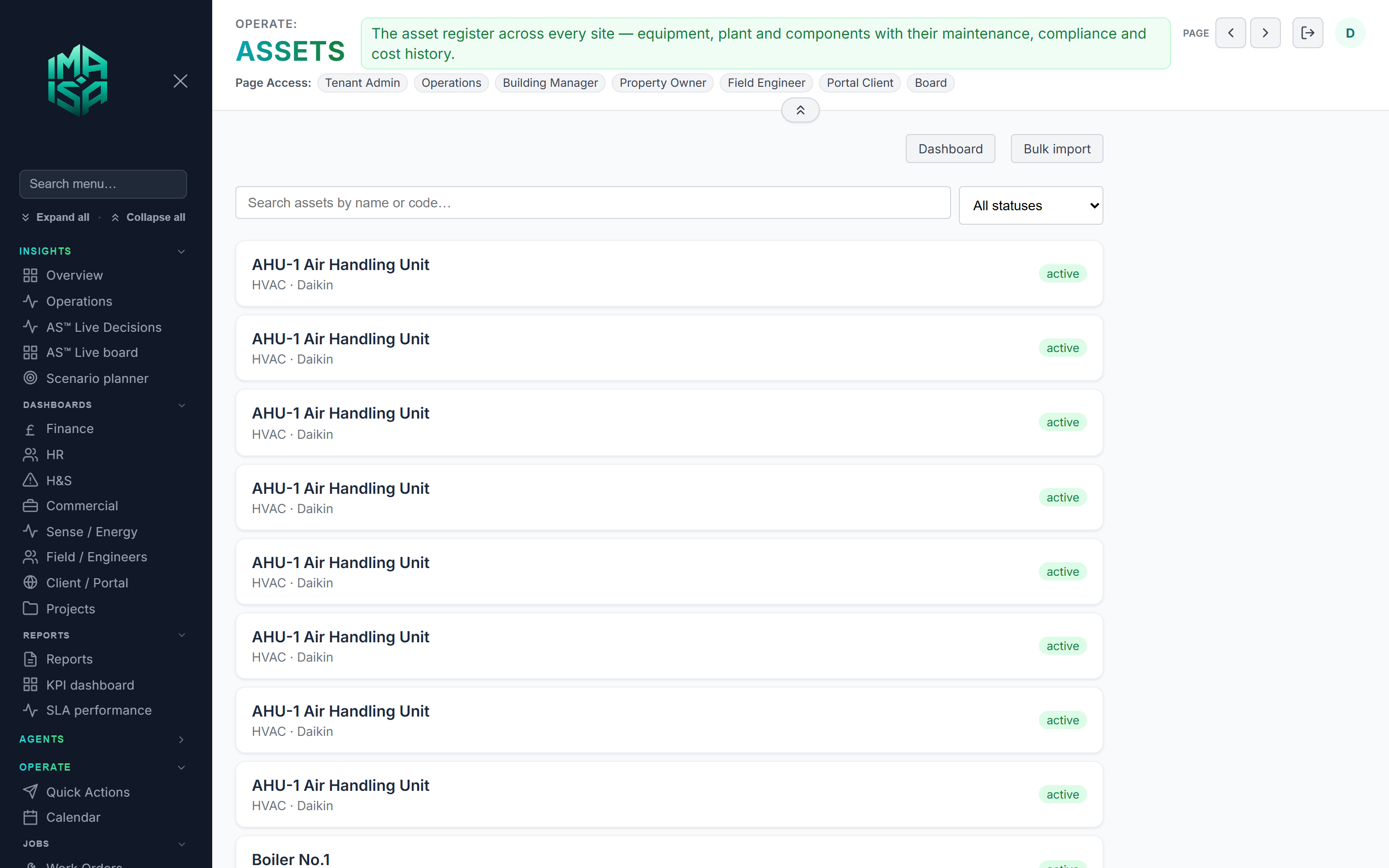
An asset register that is statutory-native: the same asset carries its UK compliance clock, its reliability history, its whole-life cost and its parts list. A human-approved AI reads the nameplate from a photo, and a field engineer scans a QR straight to the exact asset.
Why it wins
- Compliance-native — the asset statutory clock reuses the same compliance engine, not a bolt-on
- Reliability KPIs built in: MTBF, MTTR, availability and a health score per asset
- Whole-life cost on the record: depreciation, TCO and repair-vs-replace
- Human-approved AI reads the nameplate from a photo; the engineer scans a QR to the asset
How it compares
Measured on publicly available data against the named market leader(s) it replaces. Every row links its source.
| IMAISA | The market leader | |
|---|---|---|
| Compliance | The asset carries its UK statutory clock in the same engine as the work | Asset register with maintenance history; a UK multi-regime statutory clock is not built into the assetsource for the Compliance comparison |
| Reliability | MTBF, MTTR, availability and a health score per asset | Maintenance logging; MTBF/MTTR reliability KPIs not advertised as built-insource for the Reliability comparison |
| AI capture | A human-approved AI reads the nameplate from a photo — the model never writes unchecked | Manual asset data entry; no human-gated nameplate OCR publishedsource for the AI capture comparison |
Engineered across 13 architecture decision records (0282–0294) — a deliberately-built module, not a checkbox.